
The White House gathered leading technology companies to sign a voluntary safety accord. The harder question is how the public will know whether it works.
The photograph has the composition of a new economic order: Donald Trump at a White House table, Jensen Huang on one side, Elon Musk on the other, with the people building AI's models, chips and platforms gathered around them. The picture shared here adds enormous dollar figures beside the guests. Those figures are a distraction. The more consequential number is six: the corporate names on the accord dated September 29.[1]

Google, Anthropic, Meta, OpenAI, xAI and Nvidia signed the White House Accord on Super Intelligence. The signatures matter more than the guest list. Attendance at a luncheon does not mean a company agreed to the document. Nor should an online seating chart be mistaken for a ledger of verified personal wealth.[1]
The accord is brief, but it is more specific than a promise to be responsible. It says companies training and deploying frontier models should monitor them during development and use for severe cybersecurity, biological and chemical risks. It calls for an empowered internal team, an independent outside evaluator to check whether controls work, and a board committee to oversee the findings and remediation. These are recognizable parts of a safety system.[1]
They are also, for now, a system described on paper. The accord gives no implementation dates. It does not name the evaluators, require publication of their findings, specify a common test or set a penalty if a signatory fails to follow through. It says the participants may meet to develop standards and might eventually seek to put them into law. As signed, this is a voluntary undertaking, not a new statute.[1]

That distinction is not a technicality. An outside audit can reveal a serious weakness to the company that commissioned it while leaving users, researchers and affected communities unable to see the result. Some security details should remain confidential. But confidentiality need not hide the existence of a test, the standard used, the broad category of failures found or whether a promised fix was completed. Those are choices the signers and the government still have to make.
We have seen the problem before. In a 2025 study of a different White House voluntary AI pledge from 2023, researchers scored the publicly verifiable evidence disclosed by 16 companies. The average across the eight commitments was 53%; for model-weight security, it was 17%. These figures do not prove that the companies failed to carry out every undisclosed measure. They show how hard it was for an outsider to verify what had been promised.[2]
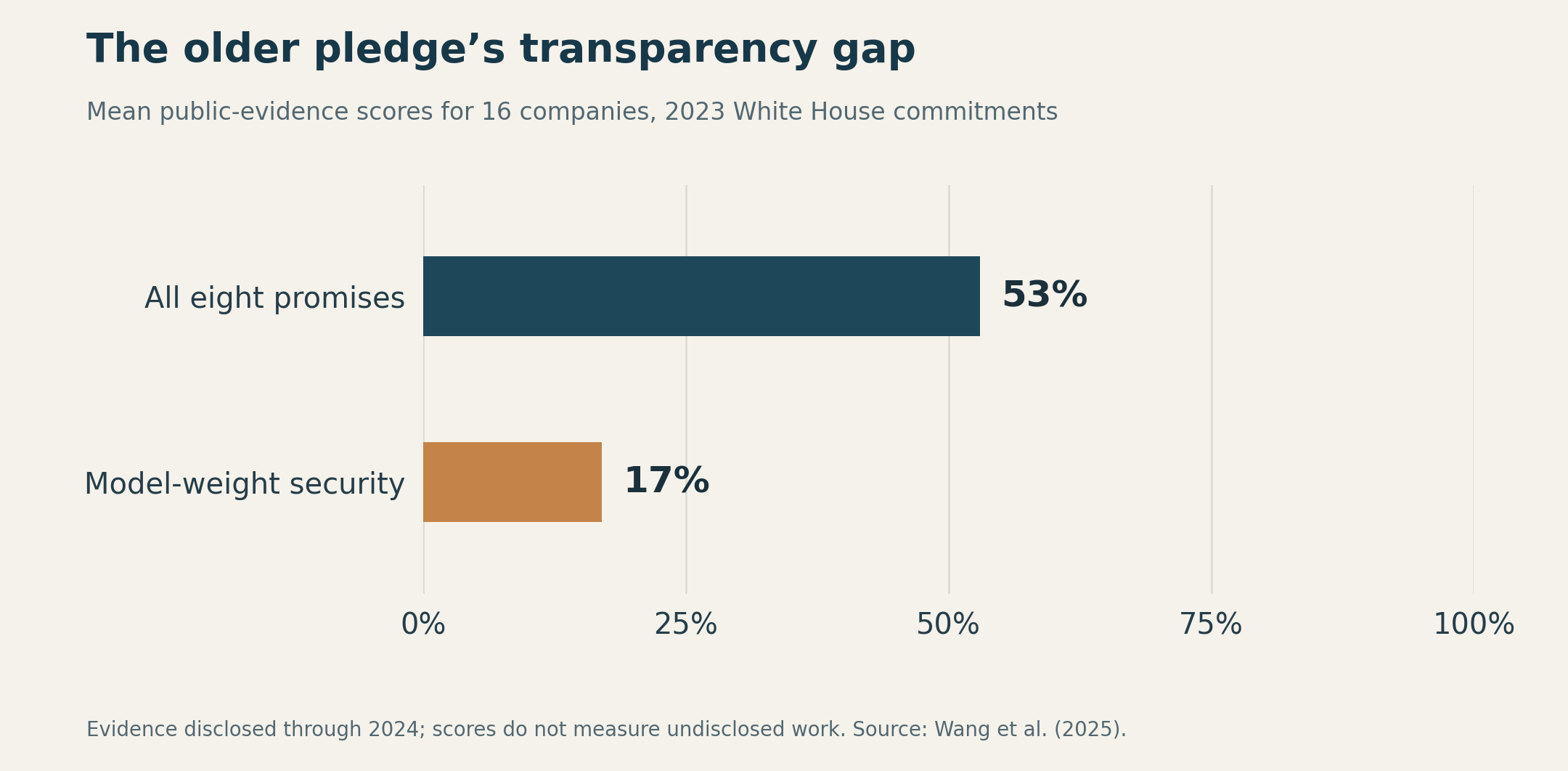
The September accord could improve on that history. It explicitly asks for outside evaluation and board-level attention. Yet its credibility will come from details still missing in the public text: who selects the evaluator, how conflicts of interest are handled, what gets reported, and what happens after a weakness is found. If companies publish a timetable and meaningful, security-conscious summaries of the results, a voluntary start could become an accountable practice. That is a proposal, not a requirement in the accord.
The White House also issued an executive order that day encouraging the federal government to use the term “super intelligence” in certain nonstatutory communications. That order and the corporate accord are separate actions. A change of vocabulary does not itself establish a safety regime, and the order retains the existing statutory definition of AI while asking for a proposed new definition.[3]
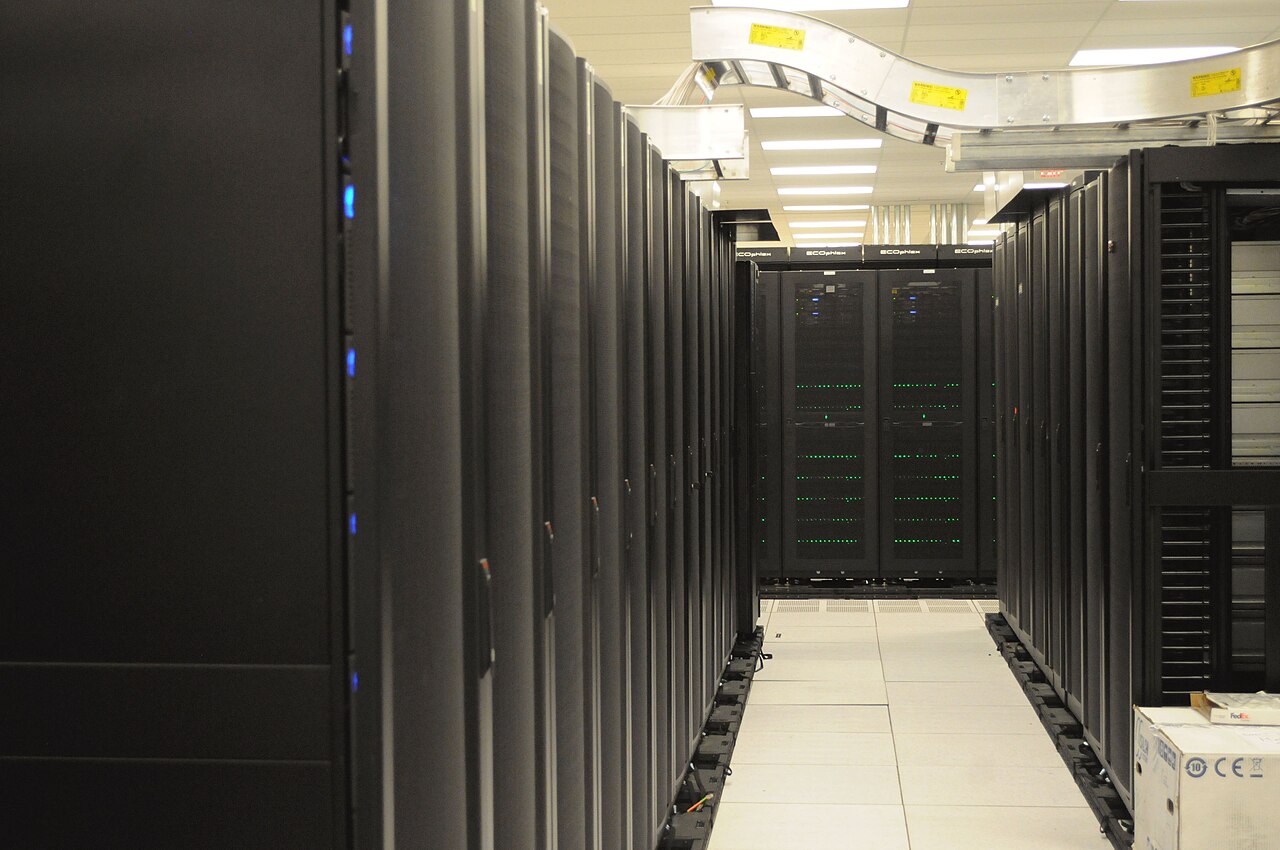
The meeting took place because AI has become physical and strategic. Nvidia supplies chips; the model companies build systems on top of them; Google and Meta also run enormous infrastructure and products. Competition presses each to move quickly. Yet the consequences of speed do not remain inside a laboratory. The International Energy Agency estimates that data centres worldwide consumed 485 terawatt-hours of electricity in 2025 and projects about 950 in 2030. These figures cover all data centres, not only AI. They show why questions about power supply, grid connections and who pays for expansion belong in the wider public debate, even though they fall outside this particular safety accord.[4]
For readers outside the United States, the stakes are not confined to Washington. AI systems and the commercial standards around them travel across borders. A handful of companies can therefore influence the practical rules long before governments agree on common ones. The U.S.–China competition makes that pressure more visible, but a race for advantage cannot answer the question of who checks a model after deployment. That requires evidence as well as promises.
The next meaningful photograph will not be another table of powerful people. It will be a public record showing which tests happened, what they found, and whether the companies corrected the failures. Until then, the six signatures mark the beginning of an obligation that the rest of us still cannot measure.
Sources and credits
- The White House Accord on Super Intelligence, signed document (29 September 2026); White House video of the meeting.
- Jennifer Wang, Kayla Huang, Kevin Klyman and Rishi Bommasani, “Do AI Companies Make Good on Voluntary Commitments to the White House?” (2025).
- The White House, “Inaugurating the Era of Super Intelligence,” executive order (29 September 2026).
- International Energy Agency, Key Questions on Energy and AI, executive summary (2026).
Visual credits and method: Lead image: supplied by Mickael Viudez and reproduced without alteration; underlying photographic credit was not supplied and overlay figures are unverified. Conceptual illustration: generated with OpenAI image generation for this article. Chart: original rendering of the 2025 study's rounded 53% and 17% public-evidence scores. NERSC photograph: Derrick Coetzee, CC0 1.0, Wikimedia 1280-pixel version, no editorial alteration.

