
Three places, one question: how much independence can you exercise when somebody else controls too many of your alternatives?

Saint-Pierre-et-Miquelon is not the first place most people would choose to explain the international order. Which is a good reason to pay attention when two leaders meet there.
On 20 September, Emmanuel Macron welcomed Mark Carney to the French archipelago off Newfoundland. It was the first official visit by a Canadian prime minister. The setting supplied a useful reminder: France is not merely Canada's partner across the Atlantic. It is also its neighbour. [1]
Set that meeting beside Carney's European diplomacy and the new Greenland security announcement, and a larger story emerges. My reading is that these are three versions of the same argument: how to cooperate with powerful countries without leaving them in charge of your choices.
Greenland: Read the Agreement

Greenland's strategic importance is not a recent discovery. The United States already operates at Pituffik Space Base, supporting missile warning and space surveillance. Washington has genuine security interests there. Recognising those interests does not settle who should govern the territory. [2]
On 18 September, Denmark and Greenland announced an expected security agreement with the United States. Their statement said signature was anticipated at the UN General Assembly, followed by the necessary national parliamentary procedures. It explicitly affirmed the Kingdom of Denmark's sovereignty and territorial integrity, alongside Greenlanders' right to self-determination. [3]
Trump offered a rather different emphasis, presenting the arrangement as permanent American control over Greenland's security. Reuters reported that important details, including the scale of the military expansion and any transfer of formal authority, had not been made public. An announcement is not the agreement's full text. [4]
That distinction matters. Military access, investment restrictions and territorial sovereignty are different things. Until the terms are available, declaring either an American takeover or a complete diplomatic victory goes beyond what can be established.
There is also a population involved, an occasionally inconvenient detail in discussions conducted over large maps. Greenlanders' right to determine their future should be central to judging the arrangement, not an ornamental sentence added after everyone else has negotiated.
Carney Looks East
Carney's 15-17 September European itinerary linked Strasbourg with Liverpool, with trade, security, energy and technology on the agenda. This was a working visit with an unusually large question behind it: how much room can Canada create for itself? [5]
In Strasbourg on 17 September, Carney proposed deeper cooperation with Europe in critical minerals, defence production, AI, energy, space and payments. The argument was about combining capabilities, not making every country self-sufficient. Europe brings industrial capacity and market scale; Canada brings resources, capital and complementary technology. [6]
The more eye-catching proposal is for Canada to become an EU "associate member". Carney welcomed the ambition, and Macron subsequently backed it. But the proposed status remains to be defined. Canada is not seeking full EU membership, and no completed accession should be inferred from the speeches. [7][8]
The label makes a headline. The substance determines whether a Canadian business gains another customer, a defence manufacturer another supplier, or a government another way to keep essential services running.
My reading is that Carney is trying to reduce the cost of disagreement with Washington. A country does not need to replace every American customer to improve its bargaining position. It needs enough credible alternatives that a dispute with one partner does not become an emergency for the whole economy.
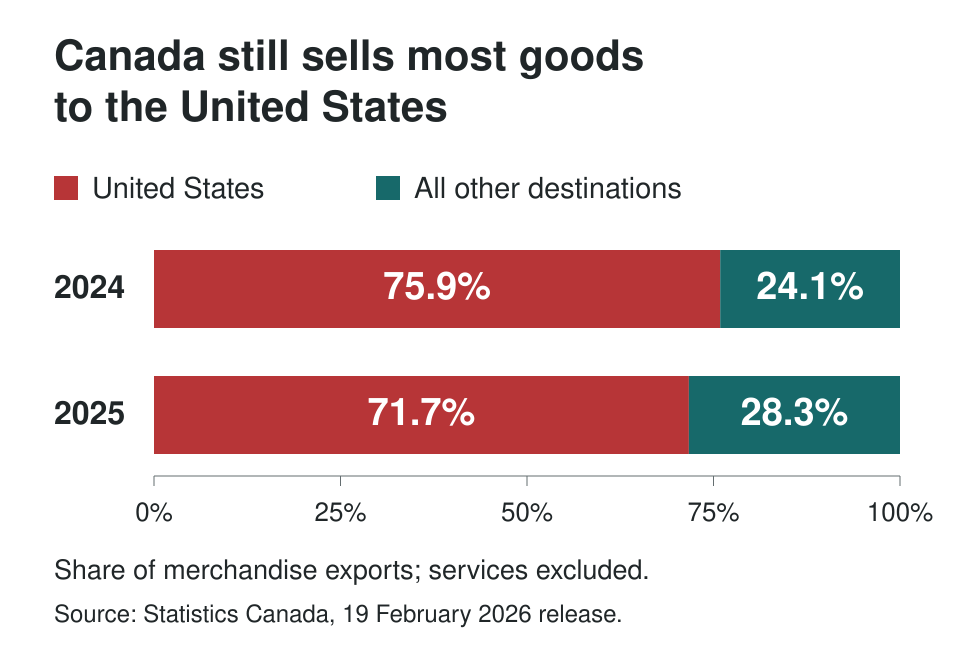
Europe cannot move next door to Canada. Fortunately, it does not need to.
France Already Is

Saint-Pierre-et-Miquelon made that last point unusually literal. The meeting also followed Trump's circulation of a map showing Canada, Greenland and other North American territories, including the French archipelago, under the American flag. Macron reaffirmed its French status. A social-media map does not change a border, but it can change the atmosphere around a meeting. [9]
The useful part went beyond the location. France and Canada directed their space agencies, defence ministries and industries to develop shared space infrastructure, including launch systems and ground facilities. They also set priorities for regional cooperation covering trade, the energy transition, climate resilience and cross-border security. [1]
Those are instructions to develop cooperation, not evidence that the infrastructure already exists. Still, they give the relationship something to work on after the leaders leave.
Macron also supported the Greenland arrangement on the understanding that it respected Danish sovereignty. That complicates any neat story about an anti-American coalition. The position is compatible with more American security cooperation, provided that cooperation does not become a claim of ownership. [7]
The common thread is therefore not exclusion of the United States. It is the ability to choose the terms of working with it.
Independence Has Costs
There is a temptation to treat a well-received speech as the first instalment of a new world order. The procurement department usually has questions.
Europe and Canada still face practical obstacles. Even CETA, their existing trade agreement, remains incompletely ratified by EU member states, including France, despite years of provisional application. Enthusiasm for a deeper relationship does not automatically resolve the arguments inside the current one. [9]
The next steps will be less photogenic. Energy partnerships need viable projects and transport capacity. Defence cooperation needs contracts, compatible equipment and delivery schedules. Shared space infrastructure needs funding, governance and clarity about who can use it when relations become difficult.
Diversification has costs too. Alternative suppliers may be more expensive. New infrastructure may take years. Governments will have to explain why paying for another option is worthwhile even before a crisis makes that option indispensable.
Nor would exchanging dependence on one dominant partner for dependence on another solve the underlying problem. The test is whether these arrangements give the participating societies more practical freedom to decide, including the freedom to disagree with each other.
Beyond the Flags
Greenland puts the limits of security cooperation under scrutiny. Carney's European diplomacy asks whether economic partnerships can widen a country's choices. Saint-Pierre-et-Miquelon gives France and Canada a place to turn that ambition into specific work.
Together, they suggest a more demanding definition of sovereignty. Keeping your flag is essential. Being able to sustain a decision after a powerful partner objects is another matter.
That is where I would judge this week's diplomacy: the published terms of the Greenland agreement, the actual content of the Canada-EU partnership, and the projects that follow the Franco-Canadian announcements.
It is easy to say a country will remain independent. The difficult part is making sure it can afford to say no.
Sources
- Prime Minister of Canada, 20 September 2026, Carney's meeting with President Macron in Saint-Pierre-et-Miquelon.
- United States Space Force, Pituffik Space Base: missile warning, missile defence and space surveillance missions.
- Danish Prime Minister's Office and Government of Greenland, 18 September 2026, Expected agreement on strengthened security in the Arctic and the North Atlantic Area.
- Reuters, 19 September 2026, Denmark says Greenland sovereignty safe under Trump's deal.
- Prime Minister of Canada, 12 September 2026, Visit to Strasbourg and Liverpool.
- Prime Minister of Canada, 17 September 2026, Address to the European Parliament.
- Associated Press, 20 September 2026, Macron backs Canada as EU associate member as Carney turns toward Europe.
- Associated Press, 17 September 2026, Carney embraces EU associate membership proposal as Trump pushes Canada closer to Europe.
- Reuters, 20 September 2026, Macron and Carney pledge closer ties in Atlantic island meeting.
- Statistics Canada, 19 February 2026, Canadian international merchandise trade, December 2025: annual export destination shares.
Editorial verification note: Based on sources available on 21 September 2026. The Greenland announcement describes an expected agreement subject to signature and parliamentary procedures; the full terms were not available in the sources reviewed. EU associate membership is a proposal, not a completed accession or an agreed final status. Strategic interpretations are the author's analysis. Confidence: high on the cited announcements and chronology; medium on their longer-term implications.


