
The next industrial map will be shaped by places that can deliver affordable, reliable electricity—and give investors a believable date for switching it on.
A new factory can have a motorway next door, a willing mayor and a generous tax break. None of them can substitute for a working electricity connection.
That is becoming a more important detail in the competition for investment.
Cheap labour has not stopped mattering. Neither have ports, suppliers or skilled engineers. But for a data centre, an aluminium smelter or an electricity-intensive production line, the power bill can change the economics of an otherwise attractive location.
Sometimes the decisive question comes before the price: can the site get enough electricity at all?
The International Energy Agency estimates that data centres consumed 485 terawatt-hours of electricity in 2025. Its April 2026 central projection puts consumption at 950 TWh in 2030—almost double. These figures cover all data centres, not AI alone, and the 2030 number is a forecast, not an accomplished fact. [1]
This is not the first time industry has followed energy. What makes the current moment interesting is the combination of digital infrastructure, electrification and competing claims on the same grid.
The new geography of cheap electricity is therefore about more than finding the lowest number on a tariff sheet. It is about finding power that can actually be used.
There are several prices hiding inside the phrase “cheap electricity”.
One is the cost of producing it. Another is the wholesale market price. A third is the bill delivered to a business, including network charges and applicable taxes. Then there is the cost of making supply dependable when the business needs it.
A sunny afternoon does not settle the economics of a factory that runs through the night.
The IEA reports that negative wholesale prices became more common in several European markets in 2025. That does not mean businesses were generally paid to consume electricity. It means electricity could have a negative market value during particular hours, while contracts and other charges continued to shape the final bill. [2]
For an investor, the useful comparison is the cost of power delivered at the required reliability, at the required location, over the life of the project.
The arithmetic becomes substantial quickly. An illustrative site drawing a constant 100 megawatts would consume 876,000 megawatt-hours in a 365-day year. A difference of US$10 per MWh would change its annual energy cost by US$8.76 million.
That calculation assumes continuous full-load operation and excludes differences in fixed charges. It is an illustration, not a quotation for a particular facility.
Still, it explains why electricity deserves a seat at the investment committee.
China’s “east data, west computing” programme offers one answer to the mismatch between where digital demand is concentrated and where energy resources are available.
The national computing-hub layout approved in 2022 was intended to connect demand in the east with computing capacity in resource-rich western regions. The official rationale explicitly identified eastern constraints on land and energy, alongside western renewable-energy potential. [3]
In May 2026, Chinese authorities announced a further action plan linking AI and energy, with objectives covering reliable electricity supply, cleaner computing infrastructure and closer coordination between computing and power systems. These are policy objectives; their announcement does not establish that every planned project is operational. [4]
The underlying economic logic is straightforward: when moving electricity is difficult or costly, moving some of the work can be another option.
That option has limits. Not every workload can be placed far from its users; response times, data rules and network connections still matter. Nor does access to renewable resources automatically provide uninterrupted electricity.
My reading is that China’s potential advantage lies in coordinating several investments together: generation, transmission, fibre networks and industrial sites. Success depends on whether that coordination produces useful, well-utilised capacity—not simply more buildings.
The United States illustrates a different constraint. Proposed generating capacity is not the same thing as electricity available to a new customer.
Berkeley Lab’s 2026 review found more than 2,060 gigawatts of generation and storage capacity in U.S. interconnection queues at the end of 2025. For the regions with available data, projects completed in 2025 had taken a median of more than five years from their interconnection request to commercial operation. [5]
Those are generation-project timelines, not a claim that every data centre waits five years. Many queued projects will never be built. The figures nevertheless show how difficult it can be to turn an investment proposal into operating infrastructure.
A business cannot run on the total capacity listed in a queue.
This changes the value of a site that already has usable electrical infrastructure. A less fashionable location with a credible connection date may be more attractive than a prestigious address with an optimistic promise.
The substation rarely appears in the promotional brochure. It may deserve the cover.
Talking about “European electricity costs” can conceal differences large enough to matter to an investment decision.
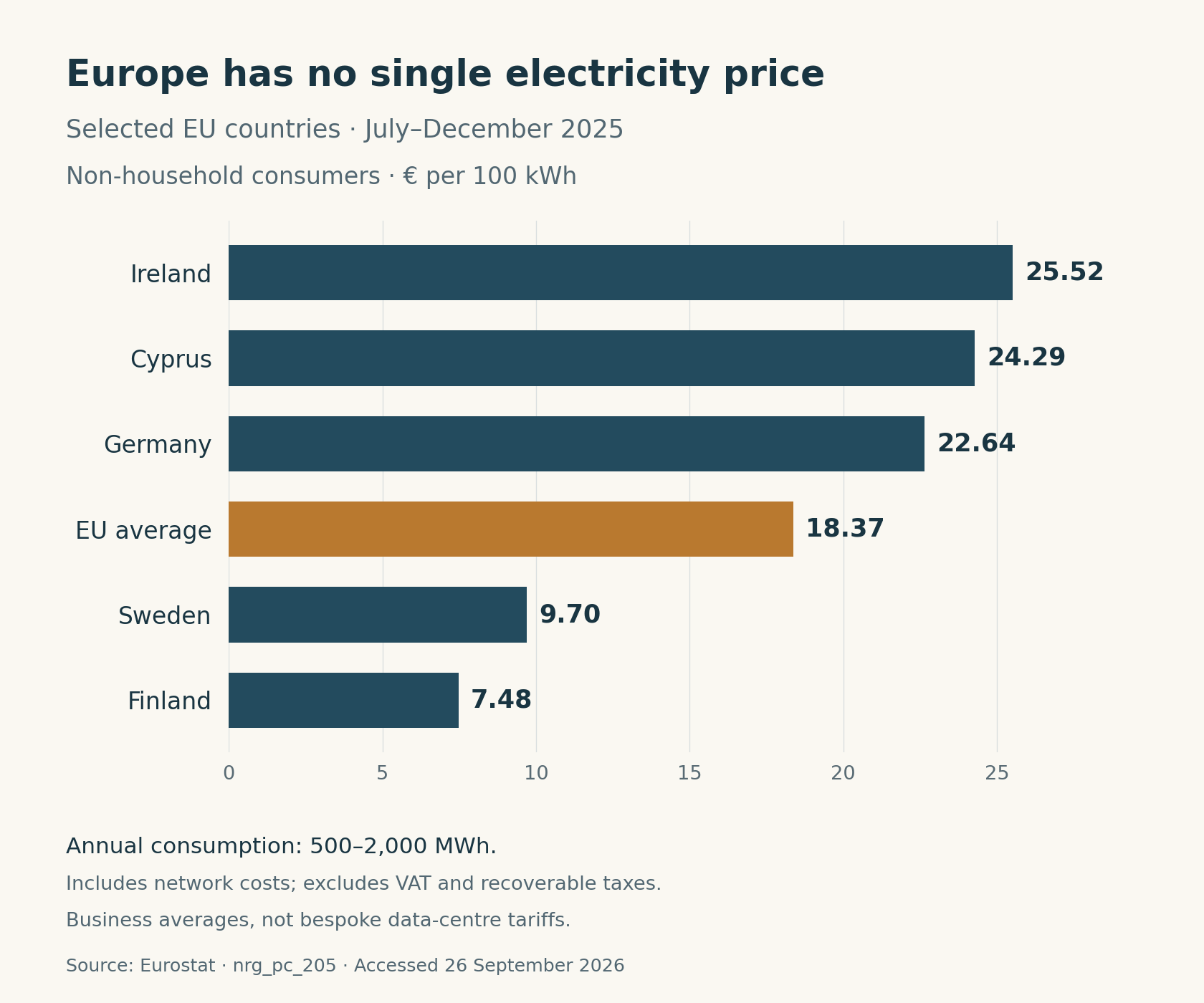
Eurostat’s comparable figures for medium-sized non-household consumers put electricity at €7.48 per 100 kWh in Finland and €25.52 in Ireland in the second half of 2025. Germany stood at €22.64; the EU average was €18.37. [6]
These are historical averages for customers consuming 500–2,000 MWh annually, excluding VAT and other recoverable taxes. They are not the prices a giant data centre would necessarily negotiate. [7]
Their value is narrower but important: even within the EU, a single headline price tells an incomplete story.
Nor is a low national average a promise that the next industrial park has spare capacity. Local congestion, contract terms and the timing of new demand can change the answer.
For European industrial policy, the implication is practical: improving access to competitively priced power can be as important as offering a subsidy to the company that wants to use it.
Québec provides a useful warning against assuming that a hydroelectric advantage means unlimited cheap access.
In February 2026, Hydro-Québec proposed a new rate for large data centres requiring more than 5 MW. Its announcement said projects above that threshold remained subject to a selection process intended to direct electricity towards uses with the greatest impact. The proposed tariff was subject to regulatory approval; the proposal should not be confused with a confirmed final rate. [8]
The policy question behind it extends far beyond Québec.
If a new customer requires expensive infrastructure, who should pay? If available capacity is limited, should priority go to computing, manufacturing, housing or another use? How should governments compare employment, tax revenue and wider economic benefits?
These questions do not disappear because the original electricity source is renewable.
Cheap power has an opportunity cost. Allocating it to one project can mean postponing another—or paying to expand the system.
The headline number attached to a proposed investment is therefore only the beginning of the evaluation. The more useful question is what the region receives in return for committing its electricity, land and infrastructure.
Electricity will not make every business relocate. Supplier networks, skills, market access and regulation can outweigh a cheaper power contract. A factory is not a spreadsheet with a plug attached.
But for electricity-intensive activities, the evidence points towards a more demanding definition of competitiveness.
The attractive location is not necessarily the one with the cheapest generation technology or the largest announced energy project. It is the place that can combine a manageable bill, dependable supply, a credible connection timetable and rules that remain understandable after construction begins.
Environmental constraints belong in that calculation too. Cooling requirements, local water availability and the effects of new infrastructure on communities cannot be treated as somebody else’s paperwork.
For governments, this makes grid planning part of industrial policy. For businesses, it makes the utility conversation part of choosing a location, not a final administrative step.
And for places that can deliver, electricity offers something more durable than a promotional slogan: a reason for investment to stay.
The next industrial advantage may look less like a cheap wage and more like a reliable connection.
Sources and credits
- International Energy Agency, April 2026: Key Questions on Energy and AI — Executive summary. The 2030 figure is the report’s central projection for all data centres.
- International Energy Agency, February 2026: Electricity 2026 — Prices. Used for 2025 market observations, not its early-2026 forward-price quotations.
- State Council of the People’s Republic of China / Xinhua, 18 February 2022: China approves mega project for greater computing power, digital future. Official account of the programme’s objectives.
- State Council of the People’s Republic of China / Xinhua, 8 May 2026: China to boost mutual empowerment of AI, energy. Policy announcement, not a measure of completed capacity.
- Lawrence Berkeley National Laboratory and GridTracker, 2026: Queued Up — Characteristics of Power Plants Seeking Transmission Interconnection. The 2026 edition covers queues through the end of 2025; time-to-operation statistics concern completed generation projects in regions with available data.
- Eurostat, 8 May 2026: Non-household electricity prices in 2nd half of 2025: −3.5%. Chart values in € per 100 kWh: Ireland 25.52; Cyprus 24.29; Germany 22.64; EU average 18.37; Sweden 9.70; Finland 7.48. Selected high- and low-price countries, not all EU members.
- Eurostat, data extracted April 2026: Electricity price statistics — Non-household consumers and methodology. Consumption band, tax treatment and network-charge definitions.
- Hydro-Québec, 19 February 2026: A new rate for data centres and a rate adjustment for blockchains to reflect the value of renewable electricity. Cited as a dated proposal, not confirmation of a subsequently approved tariff.
Research checked 26 September 2026. Forecasts, proposals and illustrative calculations are labelled. Confidence: high on the cited facts; medium on the forward-looking assessment of industrial location.


